
Online Course Website Template
A sales page that turns visitors into students: a clear course promise with a lesson preview, what students will be able to do, the curriculum module by module, who teaches it, results from past students, one simple price with a money-back guarantee, and answers to the usual questions.
One page keeps everything on a single scrolling page. The 8-page website opens all its pages in the editor: Home, Pricing, FAQ, Log in, Sign up, Journal, Article, Privacy.


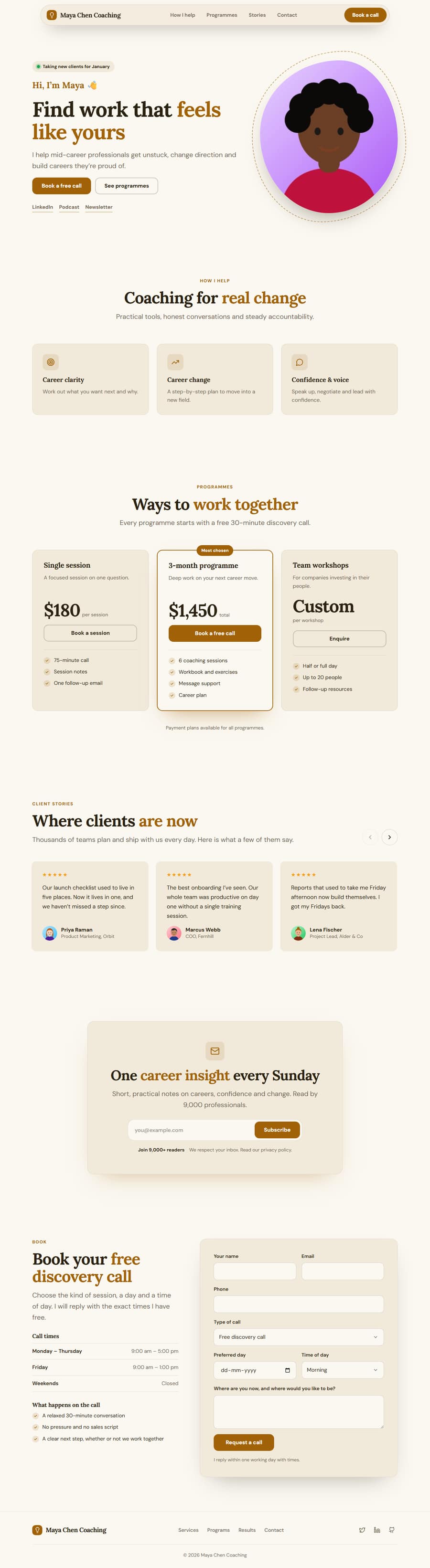


Online Course Website Template — Free, Editable, Export HTML
Education · One page or 8 pages · 12 sections · Plus Jakarta Sans + DM Sans · Responsive · GSAP animation
Extend with AI
Take This Template Further With AI
Give this prompt to an AI assistant to generate your own version of the Online Course Website template: swap in your business name, services and tone, add or remove sections, translate it, or turn the page into a Next.js project or a WordPress theme. Use the template above as the visual reference, so you and the AI start from a design that already works.
Prompt to recreate it
Copy this into your AI assistant of choice to build the effect from scratch, or as a jumping-off point for your own variant:
Build a complete online course website for “Design Academy” as clean HTML, CSS and a little JavaScript.

Page structure, top to bottom:
1. Simple Sticky Navbar
2. SaaS Split Hero: “Learn UI design in 8 weeks”
3. Icon Grid Features: “Skills you’ll actually use”
4. Video Section with Poster: “Watch the first lesson”
5. Alternating Feature Rows: “Eight weeks, step by step”
6. Horizontal Timeline: “Your 8-week learning path”
7. Testimonial Spotlight: “Priya Raman”
8. Single Plan Pricing: “One price, everything included”
9. FAQ Accordion: “Questions about the course”
10. Popup & Promo Modal
11. Minimal Footer
12. Back to Top Button

Look and feel:
- Colours as CSS custom properties: brand #f97316, page background #fffcf8, cards #fff1e6, text #1c1917, muted text #57534e. Corner radius 14px, content width 1200px.
- Headings in Plus Jakarta Sans, body text in DM Sans (load both from Google Fonts with display=swap).
- Mobile first. Sections use CSS grid or flexbox and stack cleanly below 700px.

Content:
- Write real, believable education copy for every section instead of lorem ipsum: specific offers, numbers, names and calls to action.
- One clear primary action in the hero and again near the end.

Quality:
- Semantic HTML (header, main, section, footer) with exactly one h1, the hero headline, and one h2 per section.
- Accessible: alt text on every image, visible focus states, labelled form fields, buttons and links with clear text, and prefers-reduced-motion respected.
- SEO: title “Online Course Landing Page Template — Free HTML Template”, a meta description of 150 to 160 characters, Open Graph tags and JSON-LD that suits a education business.
- Optional: a subtle GSAP ScrollTrigger fade-up on section headings, with content visible without JavaScript.

Also create these pages with the same navbar, footer and theme, and link them from the menu:
- Pricing (pricing.html)
- FAQ (faq.html)
- Log in (login.html)
- Sign up (register.html)
- Journal (blog.html)
- Article (article.html)
- Privacy (privacy.html)
Want to tighten it up first? Run this prompt through the AI Prompt Studio to score it across 8 quality dimensions, catch anti-patterns, and tune the wording for Claude, ChatGPT, or Gemini before you paste it in.
Multi-page version
Pages in the 8-Page Online Course Website Template
What's included
Sections in the Online Course Website Template
About this template
A Free Online Course Website Template You Can Edit Online
A sales page that turns visitors into students: a clear course promise with a lesson preview, what students will be able to do, the curriculum module by module, who teaches it, results from past students, one simple price with a money-back guarantee, and answers to the usual questions.
Use it as one scrolling page, or as a 8-page website (Home, Pricing, FAQ, Log in, Sign up, Journal, Article, Privacy) sharing one navbar, footer and theme. The one-page version is built from 12 sections of the Website Section Templates library and opens in the free Website Builder, where you can change every word and image, swap sections, set your own colours and fonts and export the finished site as clean HTML pages. The page is responsive, accessible and animated with GSAP, with content that stays visible without JavaScript.
The template ships with a Plus Jakarta Sans and DM Sans font pairing and a colour theme suited to online course websites; switch to any Google Font, upload your own, or apply your brand kit in one click.
Extras included
Extras Built Into the Online Course Website Template
Beyond the standard sections, the Online Course Website template includes 2 extras that you can edit, move or remove in the builder.
Horizontal Timeline: a pinned horizontal syllabus that walks through the eight weeks of the course.
Back to Top Button: a floating back to top button that appears after the visitor scrolls, so a long page is easy to leave and return.
Each extra has its own page in the free Website Section Templates library, where you can try its settings on their own before you use it here.
Make it yours
How to Get the Most From the Online Course Website Template
A course page has to sell a transformation, not a syllabus. This template opens with a badge for the next start date and a clear promise, lists the skills students gain, walks through the curriculum week by week, adds a featured student story and then shows a single price with everything included. An FAQ handles refunds, time commitment and access, which is where most last-minute doubts sit.
Write the headline as the outcome, such as the portfolio piece or job skill students leave with, and show the real project from each module. Keep one price and one enrol button to avoid choice paralysis, and state the start date and the guarantee clearly. The multi-page version adds Pricing and FAQ pages if you want separate addresses for them. Connect the enrol button to your checkout page on Stripe, Gumroad or your platform. A preview-lesson video section sits after the benefits, so prospective students can see the teaching style before they enrol.
Checklist
What a online course Website Needs
Who it’s for
Best For
Step by step
How to Use This Template
- 1Open the templateClick “Use as one page” or “Use as 8-page website” to load it in the Website Builder. Your current website is kept in Saved.
- 2Make it yoursClick any section to change its text, images and links; upload your logo and photos.
- 3Set your brandPick colours and fonts in the Theme tab, or apply your saved brand kit.
- 4Adjust the pageAdd sections from the library, drag to reorder, duplicate or remove what you don’t need.
- 5Export and publishDownload the ZIP (one HTML file per page for the multi-page version) and upload it to Netlify, Vercel or any host.
Got questions?
Frequently Asked Questions
The result students get, who the course is for, the curriculum, proof from past students, the price and an FAQ on refunds and time commitment. Keep one enrol button repeated down the page.
Yes. Each button has a link field: paste your checkout URL from Stripe, Gumroad, Teachable or any platform. The page itself does not process payments.
The alternating features section works well for modules: one row per week with a heading, text and an image, which you can reorder or extend. Add the project students complete at the end of each module.
Both. For a cohort, use the start-date badge and a deadline in the call to action. For a self-paced course, remove the date and lead with lifetime access and a refund guarantee.
Yes. The Online Course Website template is free for personal and commercial use, with no sign-up, no watermark and no attribution required.
Click “Use this template” to open it in the free Website Builder. Click any section to change its text, images and links, change colours and fonts for the whole page in the Theme tab, and add, remove or drag sections to reorder them.
Both. Use it as one scrolling page, or as a 8-page website (Home, Pricing, FAQ, Log in, Sign up, Journal, Article, Privacy) that opens with every page in the editor. The pages share one navbar, footer and theme, and the menu links to every page automatically. Add more pages (About, Pricing, Contact, Blog and others) or remove any you don’t need in the builder’s Pages tab.
Yes. As one page you get a ZIP with index.html and an assets folder. As a 8-page website you get one HTML file per page (index.html, pricing.html, faq.html, login.html, register.html, blog.html, article.html, privacy.html), a shared styles.css and script.js, and an assets folder with your images, then upload it to any web host. Links between pages also work when you open the files from your computer.